Hans Ruesch
(1913-2007)
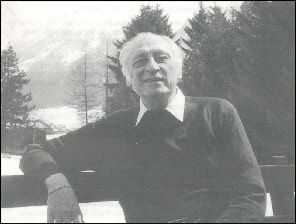 «Hans
Ruesch was born in Naples on
May 17, 1913. Both his parents were Swiss, sons of Swiss
manufacturers established in Naples. His mother Ginevra, daughter of
Filippo Büchy of the Canton of Argovia, took the Italian
nationality; his father remained Swiss and registered his son at the
Swiss consulate of Naples, which made of Hans a Swiss citizen from
birth in all respects, thanks to an agreement between the two
Countries.
«Hans
Ruesch was born in Naples on
May 17, 1913. Both his parents were Swiss, sons of Swiss
manufacturers established in Naples. His mother Ginevra, daughter of
Filippo Büchy of the Canton of Argovia, took the Italian
nationality; his father remained Swiss and registered his son at the
Swiss consulate of Naples, which made of Hans a Swiss citizen from
birth in all respects, thanks to an agreement between the two
Countries.
Hans went to
school in Naples until
the age of 12 years, then in order to finish his studies he was sent
to his country, both French and German Switzerland, thus becoming
multilingual. After an interlude of 8 years, in which he travelled
all Europe and Africa (Tripolitania and South Africa) and in which he
indulged in his juvenile passion for the car races of Formula 1 where
he ran also for the Ferrari Team, in October 1938 he migrated to the
United States, in order to continue the literary career he had begun
at the time of the races. In fact in 1937 in Switzerland
his first novel
came out, written in German, and having as its subject-matter the
world of F1 car races. Subsequently he translated it into English,
and in 1953 Darryl Zanuck of Twentieth Century Fox made in into a
movie featuring Kirk Douglas in the role of the protagonist. The
title of the movie was The
Racers.
After the war he
returned in Europe on
ship, and in January 1946 he landed in Naples, which had been
devastated by the American bombing; it was the time when he set his
novel The
Stealers,
which he wrote years later. This novel, originally written in
English, was translated by himself in Italian. In the meantime, in
1950, the United States his
first bestseller had appeared, Top
of the World,
which was also made into a movie ten years later with the title White
Shadows,
featuring Anthony Quinn.
After publishing South of the
Heart, The Game, Com'esser poveri, The
Stealers and Back to Top of the World, all written at
first in English and then translated into Italian by himself, he
stopped writing novels in order to devote himself to fighting the
swindle of the vivisection, which is performed with the excuse of
being medical research. Having studied medicine for years and edited
for a publishing house a medical series called “The Handbooks
of the Health”, he is convinced, like many others, that
vivisection is nothing else than a most lucrative swindle, which
attracts funds for a supposedly “medical research” that,
however, many doctors consider not only useless but even misleading.
In fact the diseases still indicated as the main causes of death –
cancer, diabetes, heart problems – not only have not
disappeared, but they have increased since vivisection was
introduced as the only method of [basic] “medical
research”.
These ideas, presented in the book
Imperatrice nuda, the first book Hans Ruesch ever wrote
directly in Italian [and which was published in English by Bantam
Books in 1978 in a greatly expanded version, with a different title
required by the American publisher, Slaughter of the Innocent],
aroused a scandal in Italy when the book appeared in January 1976,
putting also an end to the literary career of its author. Then he had
to start a pilgrimage from a justice court to another in several
countries, not openly sued by the pharmaceutical industry, as one
might logically assume, but by false friends. This is the subject of
his subsequent book, entitled the Counterfeiters of Justice,
which he still hopes to be able to finish.
In the meantime Prentice Hall, the
primary American publisher of educational books, issued in 2003 a new
anthology, nearly 800 pages long, devised for the university and
entitled Past to present: ideas that changed our world.
Among the 73 authors of which long excerpts are reprinted, there is
also Hans Ruesch. What is the work which has been selected? Why, it
is the one that had been suppressed in all 9 countries where it had
appeared: Imperatrice nuda.»
The text above
is a new translation of an Italian text which had been approved by
the author. Hans Ruesch died at 94 in his home in Massagno, near
Lugano, on August 27, 2007.
The obituaries appeared in the
world press have been mostly of low or very low quality. They deal
essentially on Ruesch’s s “first life” (i.e. the
racing years) and say little or nothing of the other two lives –
which would be, even from a strictly journalistic viewpoint,
particularly obtuse if it were not deliberate, since it is to his
role as antivivisection writer and leader that Ruesch owes his place
in the history of human civilization.
Typical of the
English-speaking press is the article published by New
York Times
(“Hans
Ruesch, Writer and Grand Prix Winner, Dies at 94”),
which, quite astutely, has been put in the “Sports”
section, and which says:
His nonfiction
book “Slaughter of the Innocent” (Civitas Publications,
1983), first published in Europe in
the 1970s, is credited with helping galvanize the animal-rights
movement here and abroad.
It is hard to misinform so much
with so few words. Slaughter of the Innocent, which is the
(very) enlarged version of Imperatrice nuda (appeared
in 1976), was published for the first time not in Europe, but in
the United States; not in 1983, but in 1978; not by a
small publisher (notice that Civitas is the imprint of the Hans
Ruesch Foundation), but by was at the time the America’s
largest publishing house, Bantam Books. Most importantly, Ruesch
spent a lot of energy in his last thirty years to emphasize that
opposition to vivisection requires no acceptance of the animal-rights
philosophy (although the latter has sometimes led people to take an
interest in the former), and that to further this confusion is a
means of defusing the AV movement.
By the way, the
fact that in U.S. a
book which has “galvanized” (to repeat the silly
vivisectionist metaphor used by the NYT writer) people all over the
world had to be printed and distributed mostly by the direct
intervention and investment of its author is very useful to
understand how big publishers work. They are ready to remove from
circulation a potential blockbuster in order to comply with the
powers-that-be from which their very existence and profits ultimately
depend. But you cannot expect that a falsely independent journalism
will stress this point for the benefit of its readers.